
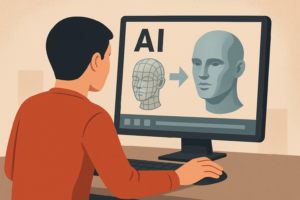
There was a time when building a 3D model was a long, painful process. Every detail had to be sculpted, textured, and polished by hand. A single asset could take days, sometimes weeks, and even then the results depended heavily on skill and experience. For many years, that was the standard: countless hours in front of a screen, refining vertices and UVs until it finally came together.
But things are changing fast. AI is reshaping the way 3D is made. What used to require advanced knowledge can now be generated from an image, or even just a line of text. “Image to 3D” and “Text to 3D” are no longer experimental concepts they’re becoming tools that anyone can access. The time barrier is collapsing, and the process itself feels less intimidating than ever before.
This exponential growth brings two sides of the story. On one hand, AI makes 3D more accessible, opening doors for people who might never have had the chance to explore it. On the other hand, it also raises the uncomfortable question: what happens to 3D artists?
It’s not just about whether jobs will disappear it’s about how the role itself is changing. Tasks that once defined the profession, like retopology or manual sculpting, might become less relevant in the near future. Yet, it’s also possible that this shift will push artists to a different kind of focus: creativity, vision, and the ability to guide AI rather than compete with it.
The truth is, nobody really knows how the next few years will unfold. Maybe AI will automate more than we expect, or maybe it will open new roles we haven’t imagined yet. What’s clear is that adaptability will be the survival skill of this era.
For now, the best move is not to resist AI, but to learn how to work with it—how to use it as an extension of our own creativity. Because at the end of the day, even if machines can generate forms and textures, it’s still the human perspective that gives meaning to the art.
141 Responses